Businesses around the world are operating in an increasingly unpredictable economic environment.
Geopolitical tensions, changing trade conditions, energy price pressures, inflation risks, higher operating costs, and uncertainty in global financial markets are making it more important for organizations to understand their financial position and prepare for different scenarios.
The International Monetary Fund projects global growth to slow to 3.1% in 2026, while warning that geopolitical tensions, renewed trade disruptions, financial market volatility, and elevated debt could create additional downside risks.
For businesses in Kenya, the environment is mixed. Kenya’s economy remains relatively resilient, with the World Bank projecting 4.7% growth in 2026, but it also highlights elevated uncertainty, debt vulnerabilities, commodity-price risks, and potential effects from weaker global growth.
The question for businesses is therefore not simply “Will the economy grow?”
The more important question is:
“Is our organization financially and operationally prepared if conditions change?”
What Is Business Resilience?
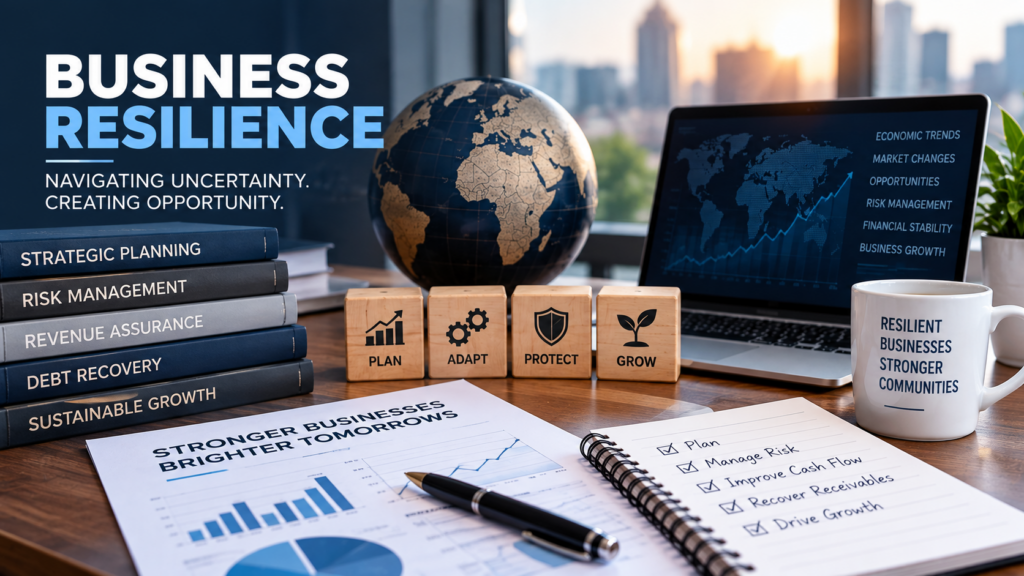
Business resilience is an organization’s ability to continue operating, manage disruptions, protect its finances, and adapt when circumstances change.
A resilient business does not necessarily avoid every challenge. Instead, it has systems and processes that allow it to identify risks early, respond quickly, protect cash flow, and continue pursuing its strategic objectives.
This is becoming increasingly important as businesses face pressure from several directions at once.
Why Cash Flow Matters More During Uncertain Times
A business can be profitable on paper and still experience serious cash-flow problems.
Customers may delay payments. Operating costs may increase. Suppliers may change their terms. Financing may become more expensive. New projects may require additional working capital.
When these pressures occur simultaneously, businesses with weak receivables management can quickly find themselves under financial pressure.
This is why cash-flow management and debt recovery should be treated as strategic priorities, rather than simply accounting functions.
Outstanding Debts Can Become a Major Business Risk
One of the biggest challenges facing organizations is money that has been earned but has not yet been collected.
Unpaid invoices and overdue accounts reduce the amount of cash available to the business.
During stable economic periods, an organization may be able to absorb some delayed payments. During periods of uncertainty, however, prolonged delays can create significant pressure.
Businesses should therefore pay close attention to:
- Overdue invoices
- Customer payment patterns
- Long-outstanding accounts
- Broken payment commitments
- Customer credit exposure
- Unresolved account disputes
- Concentration of receivables
- Increasing debtor balances
Early identification allows management to take action before receivables become difficult to recover.
Strengthening Debt Recovery Processes
A professional debt recovery process can help organizations improve collections while maintaining appropriate relationships with customers.
Rather than waiting until an account becomes seriously overdue, businesses should establish a structured process that includes:
- Monitoring payment deadlines
- Sending timely reminders
- Reconciling customer accounts
- Identifying disputes
- Contacting overdue customers
- Negotiating realistic payment arrangements where appropriate
- Tracking payment commitments
- Escalating unresolved accounts when necessary
The objective is not simply to pressure customers for payment.
The objective is to convert outstanding receivables into predictable cash flow.
Revenue Assurance Is Becoming More Important
Revenue leakage can become particularly costly when businesses are already operating under pressure.
Revenue assurance involves identifying and reducing situations where an organization loses revenue because of billing errors, process weaknesses, incorrect pricing, unbilled services, contractual issues, fraud, or other operational gaps.
For example, a business may have strong sales but still lose revenue because:
- Services are delivered but not billed
- Invoices contain errors
- Contract terms are not properly implemented
- Discounts are applied incorrectly
- Customer accounts are not reconciled
- Payments are not correctly allocated
- Revenue is lost through inefficient processes
Improving revenue assurance can therefore complement debt recovery.
There is little benefit in recovering receivables efficiently if new revenue continues to leak through weaknesses in the organization’s systems.
Strategic Planning Should Include Financial Resilience
Strategic planning is often associated with growth, expansion, market positioning, and long-term objectives.
However, today’s strategic planning also needs to consider resilience.
Organizations should ask:
What happens if costs increase?
What happens if customers take longer to pay?
What happens if demand falls?
What happens if financing becomes more difficult?
What happens if supply chains are disrupted?
These questions can be incorporated into strategic planning and scenario analysis.
Instead of developing one plan based on a single expected future, management can consider different scenarios and prepare appropriate responses.
Scenario Planning Can Help Businesses Prepare
Scenario planning allows organizations to consider how different external conditions could affect their operations.
For example, a business could develop:
Scenario 1: Stable Growth
Customer demand remains strong, operating costs remain manageable, and collections continue normally.
The business can focus on expansion and investment.
Scenario 2: Slower Growth
Customer demand slows and payment periods increase.
The business may need to strengthen credit control, reduce unnecessary costs, and prioritize high-value activities.
Scenario 3: Economic Shock
Operating costs increase significantly while customers experience financial pressure.
The organization may need to protect liquidity, accelerate receivables collection, renegotiate selected commitments, and revise its strategic priorities.
Scenario planning does not predict exactly what will happen.
Instead, it helps management become better prepared for what could happen.
What Kenyan Businesses Should Be Watching
Kenyan businesses are operating against a backdrop of both opportunities and risks.
The World Bank expects Kenya’s economy to remain resilient in 2026, while also identifying fiscal pressures, geopolitical tensions, commodity prices, and global economic conditions as important risks.
The Central Bank of Kenya’s July 2026 CEO survey also found that businesses remained optimistic about Kenya’s growth prospects, supported by stable business activity, improved access to credit, and technology adoption. At the same time, high operating costs and geopolitical tensions were identified as significant constraints.
This combination of optimism and uncertainty makes financial discipline particularly important.
Businesses should not respond to uncertainty by stopping growth altogether.
Instead, they should strengthen the systems that allow them to grow responsibly.
Five Actions Businesses Can Take Now
1. Review Your Receivables
Identify which customers owe money, how long the debts have been outstanding, and which accounts require immediate attention.
2. Strengthen Credit Control
Review payment terms, credit limits, customer onboarding procedures, invoice processes, and follow-up procedures.
3. Improve Revenue Assurance
Look for gaps between the products or services being delivered and the revenue actually being captured.
4. Review Your Strategic Priorities
Determine whether current objectives still reflect the organization’s financial position and operating environment.
5. Build Multiple Scenarios
Consider what would happen if revenue declined, costs increased, customers delayed payments, or financing conditions changed.
Preparing for these scenarios can help management make faster decisions when circumstances change.
The Role of Professional Business Consulting
Organizations do not always have the internal resources required to analyse every financial, operational, and strategic risk.
Professional consulting support can provide an independent perspective and help management identify areas that may require attention.
Depending on the organization’s needs, this can include:
- Strategic planning
- Debt collection and recovery
- Outsourced credit control
- Revenue assurance
- Financial analysis
- Risk assessment
- Performance monitoring
- Process improvement
- Business advisory services
The objective is to help organizations make better-informed decisions and build systems that support sustainable performance.
Building a More Resilient Business
Economic uncertainty should not automatically mean uncertainty about the future of your organization.
Businesses that maintain strong financial controls, monitor receivables, protect revenue, regularly review their strategies, and prepare for different scenarios are better positioned to respond when conditions change.
The current global environment reinforces an important lesson:
Growth matters, but the ability to sustain that growth matters just as much.
A resilient organization understands its numbers, protects its cash flow, manages its risks, and has a clear strategy for adapting to change.
How Mattan Consulting Can Help
Mattan Consulting Limited supports organizations with practical business solutions designed to improve financial performance, strengthen controls, and support sustainable growth.
Our services include Debt Collection & Recovery, Outsourced Credit Control, Revenue Assurance, Strategic Planning, and business consulting support.
If your organization is experiencing increasing overdue accounts, cash-flow pressure, revenue leakage, or uncertainty about its strategic direction, strengthening these areas can make a significant difference.
The best time to build business resilience is before you need it.


